Portable hotspots have traditionally fallen into two groups: low-cost 4G LTE MiFi devices and premium multi-gigabit 5G hotspots. 5G RedCap (Reduced Capability), introduced in 3GPP Release 17, creates a practical middle tier. This guide explains what RedCap changes at the device level, what throughput to expect, and what operators and brand owners should check when specifying a RedCap MiFi. Examples use the AceTel M06 specifications.
1. What 5G RedCap Is
RedCap is a 3GPP device category designed for 5G devices that do not need the full bandwidth and antenna count of a flagship smartphone-class modem. It keeps the 5G NR air interface and network features, including Standalone (SA) operation, while reducing device complexity in these areas:
- Channel bandwidth: up to 20 MHz in FR1 (sub-6 GHz).
- Antenna configuration: fewer receive and transmit chains. The M06 uses 2RX/1TX with internal main and diversity antennas.
- Peak rate: lower than full-bandwidth 5G, but above typical LTE Cat 4 hotspots.
2. Expected Throughput
The M06 specification lists the following peak rates. Real-world speeds depend on carrier configuration, band, signal quality and network load.
| Mode | Downlink | Uplink |
|---|---|---|
| 5G NR (RedCap, FR1 20 MHz) | 226 Mbps | 120 Mbps |
| 4G LTE | 150 Mbps | 50 Mbps |
For a personal hotspot serving laptops, phones and tablets, this is sufficient for HD streaming, video conferencing and cloud applications, and it is a substantial uplink improvement over LTE Cat 4 (50 Mbps).
3. RedCap vs. Other Hotspot Classes
| Criterion | 4G LTE Cat 4 MiFi | 5G RedCap MiFi | Full-Bandwidth 5G MiFi |
|---|---|---|---|
| Standard | LTE | 3GPP Rel. 17 RedCap | 3GPP Rel. 15/16 5G NR |
| Peak downlink (example) | 150 Mbps | 226 Mbps | Multi-gigabit class |
| Network mode | 4G only | 5G SA + 4G fallback | 5G SA/NSA + 4G fallback |
| Typical fit | Entry-level, cost-driven programs | Mainstream 5G, balanced cost and battery | Premium, high-throughput use |
Examples in the AceTel range: the M100 4G LTE MiFi for entry-level programs, the M06 5G RedCap MiFi for mainstream 5G, and the R875H 5G MiFi for multi-gigabit use.
4. Wi-Fi 6 Design Considerations
A hotspot’s cellular speed is only useful if the local wireless link can carry it. The M06 uses the AIC8800D40L chipset with a 1x1 antenna, supporting:
- 2.4 GHz IEEE 802.11 b/g/n/ax and 5 GHz IEEE 802.11 a/n/ac/ax.
- Up to 286.8 Mbps Wi-Fi link rate, matched to the RedCap cellular rate.
- TKIP/AES/SAE encryption with WPA/WPA2/WPA3-Personal.
- Up to 10 connected devices, with SSID, channel and bandwidth settings available in the Web UI.
5. Band Coverage: Read the Spec Sheet Against Your Carrier
RedCap performance means nothing if the device lacks your operator’s bands. The M06 is offered in three regional band configurations:
| Version | 5G NR bands | LTE bands |
|---|---|---|
| Standard | n1 / n5 / n8 / n28 / n41 / n78 | B1 / B3 / B5 / B8 / B34 / B39 / B40 / B41 |
| EU | n1 / n3 / n7 / n8 / n20 / n28 / n38 / n78 | B1 / B3 / B7 / B8 / B20 / B28 / B38 / B40 |
| North America | n2 / n5 / n25 / n41 / n66 / n71 / n77 | B2 / B4 / B5 / B12 / B13 / B14 / B17 / B25 / B26 / B41 / B66 / B71 |
Regional band lists are confirmed by AceTel engineering at quotation, and certification scope (for example CE for Europe and FCC for North America) follows the final band configuration.
- Europe: n1, n3, n7, n8 and n20 cover the FDD capacity and coverage layers used by many European operators, with n28 and n78 added for 700 MHz and 3.5 GHz deployments.
- North America: n2, n5, n25, n66 and n71 cover the main FDD layers, with n41 and n77 for mid-band capacity.
- Practical rule: list your operator’s 5G SA bands first, tick them against the table above, and ask for a variant review if any required band is missing. Do not rely on the LTE fallback alone, because it removes the 5G SA features you are buying RedCap for.
6. SIM and eSIM Architecture
Operator programs often need more than one subscription profile on the same hardware. The M06 provides 2x Nano SIM slots and 2x eSIM profiles, with PIN/PUK management and automatic network search. Specification points to confirm with your carrier:
- How many profiles must be active or switchable in the field.
- Whether eSIM provisioning is handled by the operator platform or by a travel-SIM partner.
- Roaming behavior and default network mode (the M06 defaults to automatic, with 5G prioritized over 4G).
7. Battery, Charging and Thermal Envelope
The M06 uses a 3500mAh removable Li-ion battery (3.8V nominal) with a charger limit of 1.5A and JEITA temperature-aware charging, over a USB Type-C port. The rated operating range is 0 to 40°C. A removable battery simplifies replacement and shipping variants, but sustained high-load operation in hot environments should be validated during pilot testing. Runtime figures depend on network conditions, traffic and number of connected clients, so measure them on your own target network.
8. Management and Update Path
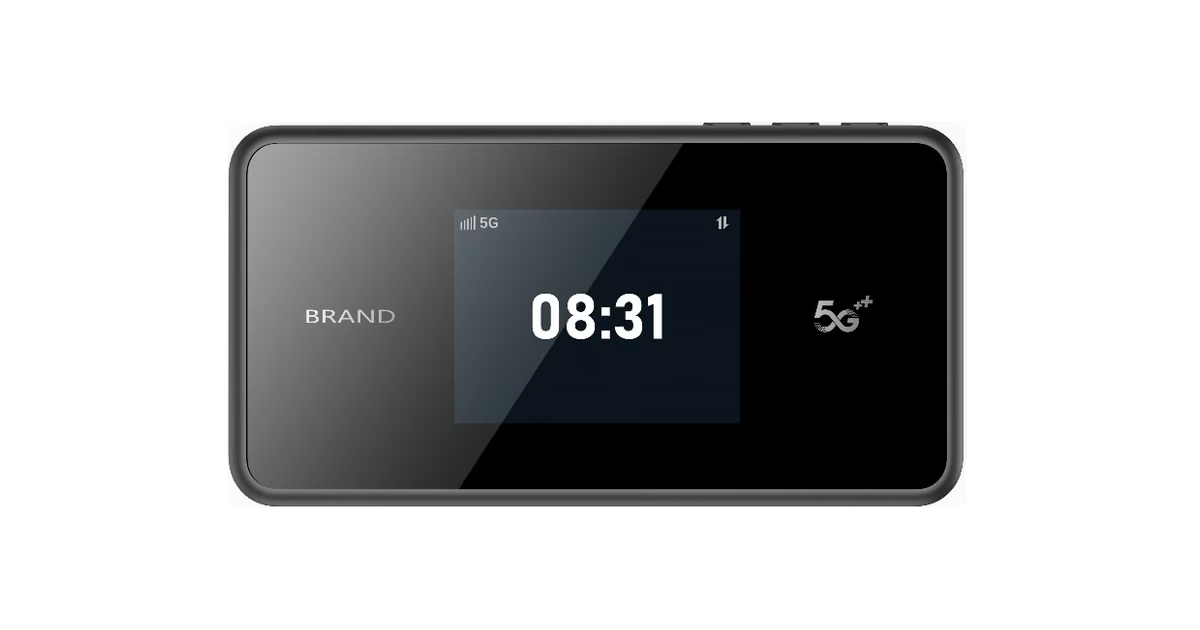
Fleet-scale programs need predictable software maintenance. The M06 supports local firmware update, FOTA, backup and restore through the Web UI, PIN/PUK management and SMS, and an on-device GUI on the 2.4-inch LCD (signal, network mode, rate, battery, Wi-Fi status, connected user count and SMS).
9. Evaluation Checklist for RedCap MiFi Projects
- Carrier compatibility: confirm RedCap support on the target network, including SA availability, and verify required bands against the standard, EU or North America M06 configuration (see section 5).
- Fallback behavior: test 5G to 4G handover and reselection at the cell edge.
- Throughput: measure downlink and uplink on the live network with several connected clients.
- SIM/eSIM provisioning: validate profile download, switching and roaming flows.
- Battery runtime and temperature: log runtime under realistic traffic and ambient conditions.
- Certification: confirm region requirements; the M06 lists CE, FCC, CCC, SRRC, NAL and RoHS, with others as required.
- Branding scope: define housing finish, logo, display carrier logo, UI language and packaging early to align lead time.
Technical Inquiries & Evaluation Samples
AceTel provides engineering samples, customization support and direct Field Application Engineer (FAE) assistance for operators and brand owners evaluating 5G RedCap hotspots. View the AceTel M06 specifications →
Contact our sales engineering team at [email protected] or request a quote on the product page.
Technical insight published by AceTel's Field Application Engineering (FAE) and Hardware Architecture team. Tested across 3GPP and carrier-grade RF laboratory standards. Have project questions? Consult our engineers.